To Serve…
My job is to serve you, the traveling public. My job description is to get you from point A to point B safely, and as on time as possible.
At times pilots find ourselves extremely worn out when we are at work. A long day of flying, with weather, mechanical delays, de-icing, and a bunch of other issues that we deal with on any given day can wear any man, or woman, out.
I often catch myself walking from one gate to the other, completely blocking out all the passengers I walk by.
However, I always make a point when I get to the gate of the flight I’m operating to take a quick look around for any service men or woman. If there are any there, I always go and shake their hands and say thank you and spend a few minutes talking with them.
One thing that we should rally around as a country, republican, democrat, Christian, atheist, etc is our troops. You may not support the war, but you should always support our troops! It wasn’t their decision to go to war, but it was their decision to possibly give their lives to protect yours.
Monday, February 20, 2012

Friday, February 3, 2012
Simple day...not so fast
Time: 5:10 PM
“We have added a trip to your schedule for tonight. You will be operating a flight to St. Louis departing at 8:00, then ferry it back to Detroit”.
Sounds good! Not much you can do about these calls when you are on reserve. You simply wait around for a call like this; throw on your uniform and head to the airport. That’s not the interesting thing about this story.
I arrived at the airport at 7, one hour to departure as required by our company policies. In the crew room I checked in(yes, we have to check in), took a glance at the weather, grabbed my charts, said hello to a couple pilots and flight attendants and headed to the gate to get the plane ready for the flight.
Time: 7:52 PM
All passengers are on board, we have all the required paperwork and it’s time to shut the door(turn off your cell phones). Just enough time for a few checklists and then a call to ground to get our pushback clearance.
Time: 8:10 PM
“Set thrust” the captain says as I push the thrust levers up to the required spot for takeoff. We will be in St. Louis in an hour and a half.
Time: 9:40 PM
“Spoilers green…..80 Knots” I say as we touch down and start to slow to exit the runway. Coming into St. Louis we had to descend through a thick, wet layer of clouds and picked up a fair amount of ice. It isn’t warm enough on the ground for it all to melt off prior to our departure back to Detroit. We are going to have to get De-Iced. Pulling into the gate, we tell our operations that we are going to need to be De-Iced prior to departure. Their response “Uhh, we don’t have anyone here that can do that”
WHAT!!!! How can a major airport hub, like St. Louis, not have de-ice crews available? Turns out that they had sent them home for the evening, without taking a look outside and noting that the temperature was below freezing and incoming aircraft would pick up ice.
So what happens? Well, we can’t depart with ice so they had to call a De-Ice crew to come in from home. This took approximately 45 minutes to get them to the airport and then another 30 to get them into the truck and out to our plane to spray us down. So now our 10-minute turn in St. Louis just turned into a 1 hour 15 minute wait.
We won’t get home until almost midnight now. This is just an example of how a very simple day in the airline industry can turn into something completely different.
RightSeatPilot
“We have added a trip to your schedule for tonight. You will be operating a flight to St. Louis departing at 8:00, then ferry it back to Detroit”.
Sounds good! Not much you can do about these calls when you are on reserve. You simply wait around for a call like this; throw on your uniform and head to the airport. That’s not the interesting thing about this story.
I arrived at the airport at 7, one hour to departure as required by our company policies. In the crew room I checked in(yes, we have to check in), took a glance at the weather, grabbed my charts, said hello to a couple pilots and flight attendants and headed to the gate to get the plane ready for the flight.
Time: 7:52 PM
All passengers are on board, we have all the required paperwork and it’s time to shut the door(turn off your cell phones). Just enough time for a few checklists and then a call to ground to get our pushback clearance.
Time: 8:10 PM
“Set thrust” the captain says as I push the thrust levers up to the required spot for takeoff. We will be in St. Louis in an hour and a half.
Time: 9:40 PM
“Spoilers green…..80 Knots” I say as we touch down and start to slow to exit the runway. Coming into St. Louis we had to descend through a thick, wet layer of clouds and picked up a fair amount of ice. It isn’t warm enough on the ground for it all to melt off prior to our departure back to Detroit. We are going to have to get De-Iced. Pulling into the gate, we tell our operations that we are going to need to be De-Iced prior to departure. Their response “Uhh, we don’t have anyone here that can do that”
WHAT!!!! How can a major airport hub, like St. Louis, not have de-ice crews available? Turns out that they had sent them home for the evening, without taking a look outside and noting that the temperature was below freezing and incoming aircraft would pick up ice.
So what happens? Well, we can’t depart with ice so they had to call a De-Ice crew to come in from home. This took approximately 45 minutes to get them to the airport and then another 30 to get them into the truck and out to our plane to spray us down. So now our 10-minute turn in St. Louis just turned into a 1 hour 15 minute wait.
We won’t get home until almost midnight now. This is just an example of how a very simple day in the airline industry can turn into something completely different.
RightSeatPilot
Thursday, January 19, 2012
Ok...I'm Back...Again
Well...my last return to blogging wasn't very successful. I could come up with thousands of excuses, new job, commuting, work, looking for homes, etc, etc, etc.
But this time I swear I'm going to get after it and start trying to post, weekly if possible.
So with my return the the blogosphere, here's a quick update. I've been at a regional airline for about 7 months now and am finally starting to figure out this life as an airline pilot thing. How to manage your schedule, commute, eat when you can eat and sleep when you can sleep.
It has been an absolute blast learning to fly a swept wing, 50 seat, regional jet aircraft. It's amazing how after only a few hours you begin to start to feel comfortable in a new aircraft. Going from a Piper Seminole with a final approach speed of 88 KIAS to a jet with a final approach speed of anywhere from 120-145 KIAS is quite the learning experience.
So tonight I'm doing what's called a "continuous duty overnight". With these, we operate the last flight out to an out-station, usually leaving around 9pm and operate the first flight back to a major hub, around 6AM the next morning. We do get to go to a hotel, but by the time you get in the van, to the hotel, and in your bed you really only have about 4 hours to catch some shut eye. The key with these is to get some rest during the day prior and after these CDO's.
Hopefully I still have some followers!
But this time I swear I'm going to get after it and start trying to post, weekly if possible.
So with my return the the blogosphere, here's a quick update. I've been at a regional airline for about 7 months now and am finally starting to figure out this life as an airline pilot thing. How to manage your schedule, commute, eat when you can eat and sleep when you can sleep.
It has been an absolute blast learning to fly a swept wing, 50 seat, regional jet aircraft. It's amazing how after only a few hours you begin to start to feel comfortable in a new aircraft. Going from a Piper Seminole with a final approach speed of 88 KIAS to a jet with a final approach speed of anywhere from 120-145 KIAS is quite the learning experience.
So tonight I'm doing what's called a "continuous duty overnight". With these, we operate the last flight out to an out-station, usually leaving around 9pm and operate the first flight back to a major hub, around 6AM the next morning. We do get to go to a hotel, but by the time you get in the van, to the hotel, and in your bed you really only have about 4 hours to catch some shut eye. The key with these is to get some rest during the day prior and after these CDO's.
Hopefully I still have some followers!
Sunday, June 12, 2011
Finally Hired!
As mentioned in my last post the airlines are starting to hire again. It was time for me to take the next step and move on to a First Officer position at a regional airline.
I'm excited about this opportunity as it allows me to continue my development as a pilot and learn a new aircraft, CRJ-200. I'm also excited as this will allow me more time to get back to blogging about the aviation industry and what we can all learn as pilots.
Excited to get back into it. Follow me on Twitter, http://twitter.com/rightseatpilot I will be putting up a lot, more frequent posts there than here for the next month as I go through training.
Looking forward to the future!
I'm excited about this opportunity as it allows me to continue my development as a pilot and learn a new aircraft, CRJ-200. I'm also excited as this will allow me more time to get back to blogging about the aviation industry and what we can all learn as pilots.
Excited to get back into it. Follow me on Twitter, http://twitter.com/rightseatpilot I will be putting up a lot, more frequent posts there than here for the next month as I go through training.
Looking forward to the future!
Friday, April 16, 2010
New Job
The aviation industry is beginning to move again. Instructors are finally starting to get jobs either flying as freight dogs or for airlines.
Today I accepted a position as a Lead Flight Instructor. I'm very excited about this position as it will allow me to work on some management skills along with my flying skills. This position requires me to oversee a group of instructors and help with any problems they are having, help build their schedules, and provide opportunities for them to grow as flight instructors as well as helping our company continue to be the best aviation training company in the U.S.A.
Wish me luck as I take the next step in my career!
Rightseatpilot
Today I accepted a position as a Lead Flight Instructor. I'm very excited about this position as it will allow me to work on some management skills along with my flying skills. This position requires me to oversee a group of instructors and help with any problems they are having, help build their schedules, and provide opportunities for them to grow as flight instructors as well as helping our company continue to be the best aviation training company in the U.S.A.
Wish me luck as I take the next step in my career!
Rightseatpilot
Sunday, February 14, 2010
Continuing Development

Continued development is essential for any occupation or hobby. It is easy to fall into bad habits even after a few months. Aviation is an odd hobby, often times your the only person in the cockpit and it is easy to slip. We have checklists to follow but sometimes you just get "sick" of doing the same thing.
In my opinion on of the best ways to stay current/proficient is observing another pilot. Whether your a private pilot or a certified flight instructor this is a good habit to have.
Where I work we are subject to observation flights from our Lead Flight Instructors a couple times a year. They aren't there to punish just to observe you doing your job and offer tips. As an instructor this should be welcomed, not frightful.
But one thing many instructors don't realize/do is that they can observe flights as well. The other day I observed my boss doing a lesson with a student. I wanted to see how he conducted that particular lesson to improve my lesson. Even though I had most of the same information in my lesson plan, it was interesting to see how he "put together" his lesson. It flowed very well and gave me a bunch of ideas on how to make my lesson better.
I would recommend to ALL pilots to observe a flight at least once every 6 months. Maybe you've fallen into bad habits without knowing it. Or maybe you will learn a helpful trick on landings, or radio calls, or managing a flight.
Continued Development is important for all professions, especially aviation. There aren't many careers/hobbies where yours and others lives are at risk. Whether it's observing a flight, using aopa.org's interactive online courses, or doing a lesson with an instructor you are only helping yourself become a better pilot.
Rightseatpilot
Old Habits die hard
First off I want to apologize for the absence. I've been trying to stay busy with work and finishing up school. Secondly, I've decided to go away from my multi part posts and talk about some other things. I've had a lot of good things come up lately that I am more interested in writing about then that. My plan is still to get back to it, maybe re-post all of them at the same time.
So here goes.
Pilots, in general, are very habitual. We tend to do the same things prior, during, and after each and every flight. There are many reasons for this, with the amount of tasks that we have to accomplish each flight if we were to "free ball" every flight something would be bound to go wrong.
One of the most basic ways pilot's demonstrate this is with the use of checklists. Checklists greatly improve the accuracy and performance of pilots. Sure after a while it almost becomes like second nature but you still find yourself using checklists, or verifying with your checklists. I've recently read an article on doctors now beginning to use checklists for surgeries. The study showed that doctors who use the checklists have, in general terms, better surgeries. There are less mistakes, deaths, and infections with doctors using versus doctors not using checklists.
I had a perfect example of "old habit's die hard" just the other week. I was flying with a Stage Check student who just needed to do two landings to complete the stage. The weather wasn't the best, 4 miles visibility and light snow.
Because of the weather we were the only aircraft(other than the King Air) flying at that point, in fact every other aircraft was parked in a hanger. As the student ran through his preflight and before starts he used his checklists as required.
When we got to the engine start, he opened his window, visually cleared left, center, and right then proceeded to yell out the window "CLEAR PROP!" before engaging the starter.
This is when it hit me! There is ABSOLUTELY no one around, no danger to people or property near the aircraft, and possibly no reason for him to yell "clear prop". However, this is something that is shoved into our heads from flight #1. The prop will kill if you walk into it, you have to make sure the prop is clear.
Now if the student hadn't verbally cleared the prop area, there probably wouldn't have been any damage. It would, however, have taken him out of his natural routine and possibly messed up the whole flight.
Moral of the story, don't change things that work. Don't change your routine to save time or because you don't think the situation requires you do a certain thing. Professional, good pilots have put years and years into training and using checklists. Professional, good pilots will use checklists until the day they retire, or heaven forbid kill themselves not using a checklists
Rightseatpilot
So here goes.
Pilots, in general, are very habitual. We tend to do the same things prior, during, and after each and every flight. There are many reasons for this, with the amount of tasks that we have to accomplish each flight if we were to "free ball" every flight something would be bound to go wrong.
One of the most basic ways pilot's demonstrate this is with the use of checklists. Checklists greatly improve the accuracy and performance of pilots. Sure after a while it almost becomes like second nature but you still find yourself using checklists, or verifying with your checklists. I've recently read an article on doctors now beginning to use checklists for surgeries. The study showed that doctors who use the checklists have, in general terms, better surgeries. There are less mistakes, deaths, and infections with doctors using versus doctors not using checklists.
I had a perfect example of "old habit's die hard" just the other week. I was flying with a Stage Check student who just needed to do two landings to complete the stage. The weather wasn't the best, 4 miles visibility and light snow.
Because of the weather we were the only aircraft(other than the King Air) flying at that point, in fact every other aircraft was parked in a hanger. As the student ran through his preflight and before starts he used his checklists as required.
When we got to the engine start, he opened his window, visually cleared left, center, and right then proceeded to yell out the window "CLEAR PROP!" before engaging the starter.
This is when it hit me! There is ABSOLUTELY no one around, no danger to people or property near the aircraft, and possibly no reason for him to yell "clear prop". However, this is something that is shoved into our heads from flight #1. The prop will kill if you walk into it, you have to make sure the prop is clear.
Now if the student hadn't verbally cleared the prop area, there probably wouldn't have been any damage. It would, however, have taken him out of his natural routine and possibly messed up the whole flight.
Moral of the story, don't change things that work. Don't change your routine to save time or because you don't think the situation requires you do a certain thing. Professional, good pilots have put years and years into training and using checklists. Professional, good pilots will use checklists until the day they retire, or heaven forbid kill themselves not using a checklists
Rightseatpilot
Thursday, February 4, 2010
Plan Ahead
Now that you've decided why you want to learn to fly airplanes comes the next step. The title is simple enough but there is a lot to think about. You need to know that this is going to take you awhile to accomplish your goal.
Let's talk minimums...40 hours of flying before you can even take the practical, 20 with an instructor. That's it, the minimums. This is a realistic goal, I passed my practical test with 41.5 hours, however I had flown a bunch prior with family.
That's 20 hours of flying paying for an instructor AND an airplane and 20 hours of just the airplane time. It's going to add up quick. You need to know how you are going to fund your training. Try and have as much money ready to go as you can to avoid training delays.
Not only money but time is a big factor as well. Understand that if you only fly once or twice a week you will have to do some review flights. The BEST possible solution is to fly 3 - 4 times per week. I know it seems like a lot but it WILL save you money and worries!
Don't worry, you'll soon enough see the light at the end of the tunnel!
Rightseatpilot
Let's talk minimums...40 hours of flying before you can even take the practical, 20 with an instructor. That's it, the minimums. This is a realistic goal, I passed my practical test with 41.5 hours, however I had flown a bunch prior with family.
That's 20 hours of flying paying for an instructor AND an airplane and 20 hours of just the airplane time. It's going to add up quick. You need to know how you are going to fund your training. Try and have as much money ready to go as you can to avoid training delays.
Not only money but time is a big factor as well. Understand that if you only fly once or twice a week you will have to do some review flights. The BEST possible solution is to fly 3 - 4 times per week. I know it seems like a lot but it WILL save you money and worries!
Don't worry, you'll soon enough see the light at the end of the tunnel!
Rightseatpilot
Monday, January 25, 2010
Part 1 - Know What You Want
Should be an easy question shouldn't it. You want to be a pilot, you want to free your feet, surf the sky, hang with the angels. Or is there more behind your decision to become a private pilot? Are you doing it to get a job, to take your family on vacations, business, or some other reason?
Let's take a look at some of the reasons people become pilots.
Are you getting your license for the pure joy of flying? Awesome! More power to you! This is a great reason to begin flying, maybe it's something you've always wanted to do. From your first flight you will have an overwhelming sense of excitement. Be careful though, you are still susceptible to the pitfalls of training.
Maybe your getting your license for business. Again another great reason to get your license. You will quickly realize the benefits of flying to expand your business or meet customers face to face instead of through the phone or emails. You will also realize that it is another expense for your business and you better be ready to make a commitment to your companies "aviation department".
Maybe you just like to travel and want to experience places that are just a little to far to drive too. If you've done any searching about aviation then you obviously know about the $100 hamburger. You know, when you jump in a plane, fly somewhere new, grab lunch and fly home. This could be great way to take the wife(or significant other) and kids new places for the weekend!
Maybe you've accomplished a lot in your life and are looking for the next step. Maybe you want to be recognized as a pilot! That's awesome! People look up to pilots, those who can jump in a small aircraft and take control of their lives and others. BE CAREFUL with this one. If this is the reason you might be falling into a big trap of just trying to get your license so you can be recognized as a pilot.
Whatever your reasons are you need to understand what you want to get out of your newly minted private pilot certificate. If you know what you want then the next steps, and your training will go a lot smoother and you will not have as many pitfalls. Being a pilot is a great privilege and demands that you are diving head first into it! Step one.....complete!
Rightseatpilot
Friday, January 22, 2010
Getting Your Certificate
While I've written about my experiences I've been thinking back about when I was going through my training. I initially got my private pilot certificate outside of the University of North Dakota at a local airport near my hometown. Now that I'm a CFI-I I've read a few books and articles about how to attract, keep, and retain students. One of the best books I've read is "The Savvy Flight Instructor", a must read for all CFI's.
I started thinking on the other side about what students need to do to stay motivated. As is always discussed by CFI's is the standards student, the one who is extremely motivated at the beginning and looses motivation as the training goes on, often times quitting before even obtaining their Private Pilot Certificate.
What can a student do to stay motivated and achieve their certificate? In the following posts I will discuss this and provide some helpful ideas.
Part 1 - Know what you want
Part 2 - Plan ahead
Part 3 - Finding the right school
Part 4 - Stay involved
Part 5 - Understand the curve
Part 6 - The light
Part 7 - continue to learn
I started thinking on the other side about what students need to do to stay motivated. As is always discussed by CFI's is the standards student, the one who is extremely motivated at the beginning and looses motivation as the training goes on, often times quitting before even obtaining their Private Pilot Certificate.
What can a student do to stay motivated and achieve their certificate? In the following posts I will discuss this and provide some helpful ideas.
Part 1 - Know what you want
Part 2 - Plan ahead
Part 3 - Finding the right school
Part 4 - Stay involved
Part 5 - Understand the curve
Part 6 - The light
Part 7 - continue to learn
So check back and stay up to date! Expect the first post in a few days!
Rightseatpilot
Tuesday, January 19, 2010
I've Caved
I am embracing technology and have decided to start a twitter feed for RightSeatPilot. The blog and Twitter will be my way of letting everyone know what it’s like to be a flight instructor. I’m not going to abandon the blog, it will still be my primary source for posting stories and ideas.
http://twitter.com/rightseatpilot
However, I thought it would be fun to let people see what I’m doing during my day(and nights) as a flight instructor. Follow the twitter account as I will be posting what I’m doing throughout the day, flight or briefings, which course, any thoughts before or after lessons.
http://twitter.com/rightseatpilot
This is just a more active way for me to stay involved. Hope to see you follow me soon!
http://twitter.com/rightseatpilot
RightSeatPilot
Thursday, January 7, 2010
No secrets

"There are no secrets to success. It is a result of preparation, hard work, and learning from failure."
~Colin Powell, Chairman of the Joint Chiefs of Staff - and later, Secretary of State. After a Stunning victory during the first Gulf War
This quote jumped off the page when I first read it in Never Fly Solo. I instantly started thinking about how this is so true in every aspect of life. Whether it's school, sports, getting a girlfriend, or flying. Take college football for example athletes watch film all week on the upcoming team, usually anywhere from 3-5 hours a week. Preparation. They spend summers and off seasons working in the gym getting stronger, more in shape. Hard work. After every game every play is evaluated and graded, the plays that you got wrong are talked about in meetings and adjustments are made for the following week. Learning from Failure.
This quote also made me think about how it related to flying and instructing. As an instructor it is my responsibility to prepare the student, kind of. I am responsible for assigning homework, study items, things to do to prepare for each lesson. If I don't do that I'm not giving my student a chance to prepare for the lesson properly and fairly. Now it is up to them to take it upon themselves to actually come do the work and come prepared.
Flying is hard work. Sure, flying is meant to be fun but to be proficient requires hard work. You aren't just within commercial standards the first time you try a steep turn. It takes practice, work, sometimes it won't come easily to your students. But don't let them give up, find new approaches to teaching/executing a maneuver.
I've learned a lot from failure, and like to let my students fail at things as well. Think about it, which landing do you remember more? The one you greased in or the one you screwed up bad and thought you were going to go through the runway? Which one did you learn more from? As an instructor you need to let your students make mistakes, so they can learn from them. I will always let my students make mistakes, as long as it doesn't put us in a dangerous situation.
Siouxpilot
Monday, January 4, 2010
New Ideas for a New Year

With the new year here and everyone making plans and promises we should find new ways to keep the fire burning for our desire to fly. Here are some ideas for keeping that fire burning, if you have any feel free to post them.
Add a new rating or endorsement: This is a great way to keep you in the airplane. Not only are there certain requirements you need to meet but it also increases your knowledge and ability. If your a private pilot consider adding your instrument. If your a commercial pilot look at adding a CFI, nothing will improve your knowledge more than teaching someone to fly.
Fly a new aircraft: Along the same lines of adding a new rating. Get signed off in a new aircraft, perhaps a high performance or complex airplane. Or just meet new people at your local airport and try to arrange rides in their aircraft.
Go somewhere new: All of our dreams about flying started with being able to go places. Now's the chance to try. Fly somewhere for the weekend, fly to a golf course that's just to far off to drive. Take your wife or family to dinner in a different city at a new restaurant.
Take someone flying: There is no greater joy than taking someone up for the first time. Offer to take up a neighbor, or a best buddies kids. The look of enjoyment on their face will remind you why you first wanted to fly.
There are a lot of good reasons to fly and as time passes we tend to forget about them. Flying should be fun and not just a chore or something you do. Enjoy yourselves, bring joy to others with the gift of flight, and have a safe year.
Siouxpilot
Sunday, December 20, 2009
TV and Laundry
The life of a flight instructor in the midwest continues. School's over and most of the students have gone home but I'm still in Grand Forks to work with the Air China students. There is plenty of opportunity to work, build hours, and MAKE MONEY!
I'm covering 3 students, doing stage checks, and working with my students. I'm scheduled up from basically 8 till 5 or so everyday doing flights.
Of course the weather doesn't want to play nice. So for the past two days I've been sitting in my living room watching TV not making money to pay for the TV. I've also been doing a lot of laundry, I'm running out of things(and clothes) to do.
If it were warmer out I would be outside doing something but this is Grand Forks, ND and it is December. I've decided that if I am going to be doing this for I need to get a hobby. Let's see what are some options: Learning guitar, beer brewing, making videos, photography. I think I'll keep searching.
right seat pilot
Sunday, December 13, 2009
ANE - GFK
Sunday, December 13
Well my time at home is over and it's time to get back to Grand Forks. I was planning on leaving around noon but the weather looks like it's getting worse later in the day. I was also going to fly the kbrew departure out of ANE but because of weather in Fargo I decided to file direct to KGFK.
10:00am: Wheels are off exactly at my schedule departure time(lucky!)
10:10am: Level at 6,000' and cleared direct to Grand Forks
10:15am: Center advises of opposite direction traffic at my 12 1,000' above me.
10:30am: My request for 8,000' is granted and I start my climb. Great weather so I have time to snap a few pictures and mess around with the G1000.
11:15am: I'm now in the clouds. Temp is -14C. I'm always paranoid about ice so about every minute I'm looking for ANY signs of ice. I have a plan to divert the instant I see ice. No ice forms so I press on.
11:30am: Flight Watch advises that I should be clear of IFR conditions in about 20 more miles. I'll keep pressing on, still constantly watching for ice.
11:40am: Flight Watch was right, about exactly 20 NM and I am back in VFR conditions. No more worries I'm home free to GFK
12:20pm: I'm cleared for the visual approach to runway 35L.
12:25pm: Touchdown at GFK
This was an awesome trip. I got to meet a bunch of awesome people at an AWESOME company. I was so impressed with Cessna and how they operate. It is definitely a first class company. It was fun to fly places that I haven't flown before and land at new airports. Being an instructor you forget what flying is actually about. It's about the freedom to fly from Independence Kansas all the way to Minneapolis, Minnesota in less than 5 hours!
Siouxpilot
Well my time at home is over and it's time to get back to Grand Forks. I was planning on leaving around noon but the weather looks like it's getting worse later in the day. I was also going to fly the kbrew departure out of ANE but because of weather in Fargo I decided to file direct to KGFK.
10:00am: Wheels are off exactly at my schedule departure time(lucky!)
10:10am: Level at 6,000' and cleared direct to Grand Forks
10:15am: Center advises of opposite direction traffic at my 12 1,000' above me.
10:30am: My request for 8,000' is granted and I start my climb. Great weather so I have time to snap a few pictures and mess around with the G1000.

11:15am: I'm now in the clouds. Temp is -14C. I'm always paranoid about ice so about every minute I'm looking for ANY signs of ice. I have a plan to divert the instant I see ice. No ice forms so I press on.
11:30am: Flight Watch advises that I should be clear of IFR conditions in about 20 more miles. I'll keep pressing on, still constantly watching for ice.
11:40am: Flight Watch was right, about exactly 20 NM and I am back in VFR conditions. No more worries I'm home free to GFK
12:20pm: I'm cleared for the visual approach to runway 35L.
12:25pm: Touchdown at GFK
This was an awesome trip. I got to meet a bunch of awesome people at an AWESOME company. I was so impressed with Cessna and how they operate. It is definitely a first class company. It was fun to fly places that I haven't flown before and land at new airports. Being an instructor you forget what flying is actually about. It's about the freedom to fly from Independence Kansas all the way to Minneapolis, Minnesota in less than 5 hours!
Siouxpilot
IDP - OMA - ANE
Saturday, Dec 12
After a nice meal and good nights rest today is the day that we take delivery of the aircraft and start my flight back to Minneapolis. I want to say right away that the people at Cessna are all awesome people. They've treated us like royalty and are just normal people who you can have a conversation with.
8:00 am: Cessna picks us up at our hotel to take us to the factory
8:30 am: We begin to inspect our aircraft in the hanger, looking for anything that doesn't meet our expectations. Our aircraft our parked in a hanger with all the other
9:30am: Time for the acceptance flight with one of Cessna's delivery pilots. One more chance to make sure everything works right and nothing needs to be fixed before we leave IDP.
11:35am: We asked if we would be able to be given a tour of the factory and they said yes. So off we go through the factory. Very impressive. They have 2 production lines, one for the Mustang and the other for all the prop aircraft. The factory is cleaner than my room.
1:15pm: Wheels off. I'm IFR IDP direct to OMA. I'm filed for 8,000' with a time en route of around 2 hours 20 minutes.
1:45pm: Cessna 135XX is not hearing center so center asks if I can relay for him. It's a simple message just telling them to contact Kansas City center on 132.9
1:50pm: ATC must be bored. They keep asking me questions about UND and if we are picking up new aircraft. Their last question was they heard a rumor you get a free cake if you buy a new aircraft from Cessna(not true!)
2:20pm: Gotta love the mic input on the C172. I plug in my ipod and turn on a little music in the background. Sure makes time go by faster.
4:00pm: Arrival at OMA. Nice airport, I've never been there. A different UND aircraft arriving after me gets ramp checked by the FAA and passes(Whew).
4:30pm: After a quick fuel, cup of coffee, and bathroom brake I'm back rolling down the runway for departure to ANE.
4:50pm: I'm now level at 9,000 54NM from Fort Dodge VOR. I'm flying the twolf1 arrival into ANE. This takes me from oMA to FOD(fort dodge) then via VOR radials to anoka.
5:15pm: Getting dark!
 6:25pm: MSP center vectors me over the top of the international airport. I'm enjoying flying around buildings again. I spot the Metrodome, then the new I35 bridge. I start thinking I must be close to the new TCF Stadium at the UofM and look directly below and there it is, all lit up with the screen on.
6:40pm: On the ground at ANE. Time to spend a little time with the family and friends.
I'm planning on staying until Sunday before I head back to Grand Forks.

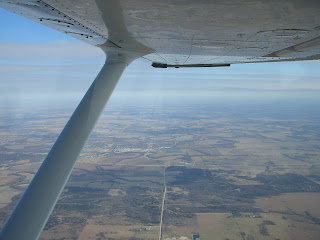


After a nice meal and good nights rest today is the day that we take delivery of the aircraft and start my flight back to Minneapolis. I want to say right away that the people at Cessna are all awesome people. They've treated us like royalty and are just normal people who you can have a conversation with.
8:00 am: Cessna picks us up at our hotel to take us to the factory
8:30 am: We begin to inspect our aircraft in the hanger, looking for anything that doesn't meet our expectations. Our aircraft our parked in a hanger with all the other

9:30am: Time for the acceptance flight with one of Cessna's delivery pilots. One more chance to make sure everything works right and nothing needs to be fixed before we leave IDP.
11:35am: We asked if we would be able to be given a tour of the factory and they said yes. So off we go through the factory. Very impressive. They have 2 production lines, one for the Mustang and the other for all the prop aircraft. The factory is cleaner than my room.
1:15pm: Wheels off. I'm IFR IDP direct to OMA. I'm filed for 8,000' with a time en route of around 2 hours 20 minutes.
1:45pm: Cessna 135XX is not hearing center so center asks if I can relay for him. It's a simple message just telling them to contact Kansas City center on 132.9
1:50pm: ATC must be bored. They keep asking me questions about UND and if we are picking up new aircraft. Their last question was they heard a rumor you get a free cake if you buy a new aircraft from Cessna(not true!)
2:20pm: Gotta love the mic input on the C172. I plug in my ipod and turn on a little music in the background. Sure makes time go by faster.
4:00pm: Arrival at OMA. Nice airport, I've never been there. A different UND aircraft arriving after me gets ramp checked by the FAA and passes(Whew).
4:30pm: After a quick fuel, cup of coffee, and bathroom brake I'm back rolling down the runway for departure to ANE.
4:50pm: I'm now level at 9,000 54NM from Fort Dodge VOR. I'm flying the twolf1 arrival into ANE. This takes me from oMA to FOD(fort dodge) then via VOR radials to anoka.
5:15pm: Getting dark!
 6:25pm: MSP center vectors me over the top of the international airport. I'm enjoying flying around buildings again. I spot the Metrodome, then the new I35 bridge. I start thinking I must be close to the new TCF Stadium at the UofM and look directly below and there it is, all lit up with the screen on.
6:40pm: On the ground at ANE. Time to spend a little time with the family and friends.
I'm planning on staying until Sunday before I head back to Grand Forks.


Delay Day
The first of three posts about my trip to pick up a new C172 at their Independence, Kansas factory.
Delay Day(Friday, Dec 11)
4:50 am: All three alarms in my room go off and I drag myself out of bed. Have to be at the airport for a 6:00AM departure in the King Air.
6:00 am: Bad news. The main strut on the King Air is leaking and we have to wait till maintenance comes. Time to head home till I get the call to come back to the airport.
12:30 pm: Heading back to the airport after a nice little nap.
2:45 pm: Wheels off
3:45 pm: Level at FL250, GS 259 kts
4:00 pm: Center "405XX we have a flight of B1's off your 9 o clock block airspace 220 thru 240. I actually watch two B1's in formation pass about 1 mile behind us.
4:35 pm: Practice approach at Sioux City, Iowa. On to Independence.
6:20 pm: Arrival at Independence, Kansas.
Time for dinner (steak), a hot tub, and some sleep. Tomorrow takes looks nice and takes me from IDP to Omaha, Nebraska and then on to Anoka, Minnesota.
Delay Day(Friday, Dec 11)

4:50 am: All three alarms in my room go off and I drag myself out of bed. Have to be at the airport for a 6:00AM departure in the King Air.
6:00 am: Bad news. The main strut on the King Air is leaking and we have to wait till maintenance comes. Time to head home till I get the call to come back to the airport.
12:30 pm: Heading back to the airport after a nice little nap.
2:45 pm: Wheels off
3:45 pm: Level at FL250, GS 259 kts
4:00 pm: Center "405XX we have a flight of B1's off your 9 o clock block airspace 220 thru 240. I actually watch two B1's in formation pass about 1 mile behind us.
4:35 pm: Practice approach at Sioux City, Iowa. On to Independence.
6:20 pm: Arrival at Independence, Kansas.
Time for dinner (steak), a hot tub, and some sleep. Tomorrow takes looks nice and takes me from IDP to Omaha, Nebraska and then on to Anoka, Minnesota.
Monday, December 7, 2009
C172 Ferry Flight
Thursday morning at 6:00 am I will be jumping on a King Air for a ride down to Wichita, Kansas. The University of North Dakota has been accepting delivery of brand new Cessna 172's for over a year now as we replace our fleet of Piper Warriors.
Three of us are going down to take delivery of 3 new airplanes. We will be doing an acceptance flight and check and then it is our responsibility to get the aircraft back to Grand Forks, ND.
Instead of coming straight back to Grand Forks my route will take me to Anoka County airport in Minneapolis, where I will spend the night with family. The following day I will head back to Grand Forks.
I'm going to write a few posts about the trip and experience.
Siouxpilot
Three of us are going down to take delivery of 3 new airplanes. We will be doing an acceptance flight and check and then it is our responsibility to get the aircraft back to Grand Forks, ND.
Instead of coming straight back to Grand Forks my route will take me to Anoka County airport in Minneapolis, where I will spend the night with family. The following day I will head back to Grand Forks.
I'm going to write a few posts about the trip and experience.
Siouxpilot
Wednesday, November 18, 2009
Upgrade
Not the type of upgrade you are accustomed to with the airlines but I have been given an upgrade in the organization at UND. Since I started instructing I've had a stretch of very good pilots come through seeking some help from me. I give the majority of my successes in teaching to the students ability/desire to learn difficult ideas. With the help of these students I've had a very impressive pass rate on stage checks. A stage check is basically a test, given by another instructor, to evaluate how a student is progressing through each course. Each course has at least one stage check and more then not two or three. The stage check consists of both an oral portion and a flight portion. To pass the stage check students need to perform to certain standards, usually the PTS standards for the given course they are enrolled in.
Because of the success my students have had I was selected to become a stage pilot. This is an awesome opportunity and something that I've wanted since I started flying here at UND. Becoming a stage pilot gives me an opportunity to also help other students. I will now be evaluating students directly, and their instructors indirectly.
During the stage check I will evaluate students knowledge and piloting ability through questions, mostly scenario based questions to prevent students from memorizing answers. During the flight I evaluate their mastery, smoothness and accuracy, and aeronautical decision making on the required maneuvers for that certain test.
I'm very happy to start doing this. I've already completed the extra required training and am just waiting approval from the FAA(hopefully this week!). I also have some great news about an adventure I get to take in December, more on that later.
Siouxpilot
Because of the success my students have had I was selected to become a stage pilot. This is an awesome opportunity and something that I've wanted since I started flying here at UND. Becoming a stage pilot gives me an opportunity to also help other students. I will now be evaluating students directly, and their instructors indirectly.
During the stage check I will evaluate students knowledge and piloting ability through questions, mostly scenario based questions to prevent students from memorizing answers. During the flight I evaluate their mastery, smoothness and accuracy, and aeronautical decision making on the required maneuvers for that certain test.
I'm very happy to start doing this. I've already completed the extra required training and am just waiting approval from the FAA(hopefully this week!). I also have some great news about an adventure I get to take in December, more on that later.
Siouxpilot
Tuesday, October 13, 2009
Aircraft Ownership for Flight training

Well, it has been a LONG TIME. I'm in a class called information systems and technology this semester and it deals with working with word, excel, powerpoint, etc... So I've been messing around with it using functions and such. I decided to make a excel spreadsheet seeing how long it would take me to make a profit if I were to purchase an aircraft and use it as a flight training aircraft. I needed to figure out how much I would have to instruct per month to eventually make a profit. What I found was kind of interesting, I'll go into a little detail in a bit. But first, this is like another post of mine where I evaluated purchasing your own aircraft for your private pilot flight training. I wanted to see if it would make more sense to purchase or rent an aircraft. Here is the link to "Rent or Buy". This was one of my favorite posts so far along with "Holy $**T Moment".
So here are the numbers I used.
Costs:
Aircraft Purchase(1970's 172) - $50,000
Annual costs (Insurance, Hanger, Maintenance) - $6,200
Rental Fees:
Aircraft Hourly Fee - $135
Instruction Hourly Fee - $45
So heres what I figured out. To break even in year 1, pay for the cost of the aircraft and other costs, I would have to fly 324 hours that year. This breaks down into just under 27 hours per month. Probably very do able, with exceptions.
There are many hard parts about flying 324 hours in year 1. The major one is getting enough customers. This is and will always be a problem for instructors. Lets say I find 3 customers in my first year working towards their private. If each of them requires 30 hours of Dual instruction I would earn $16,200 that year. Providing good instruction and recommendations then I could easily double that the next year, $32,400.
I'm sure I'm missing a bunch of stuff, including fuel costs since all aircraft rentals are usually "wet".
Just another interesting option that popped into my head. Has anybody gone this route? Could be an option in the future for this Right Seat Pilot.
Subscribe to:
Posts (Atom)


